Boyd Gaming Q2 Earnings Navigates Las Vegas Softness with Midwest Muscle
Boyd Gaming wrestles with an uneven regional picture, but strength in the Midwest and South and the promise to return $150 million per quarter to investors keep shareholders onside.

Boyd Gaming (BYD) released its second-quarter 2026 financial results after the closing bell on Thursday, delivering a mixed but ultimately stable report that highlighted the company’s geographical diversification.
While the casino operator narrowly missed Wall Street’s revenue expectations, it successfully utilized tight operational efficiency and a broad capital investment program to post an earnings beat.
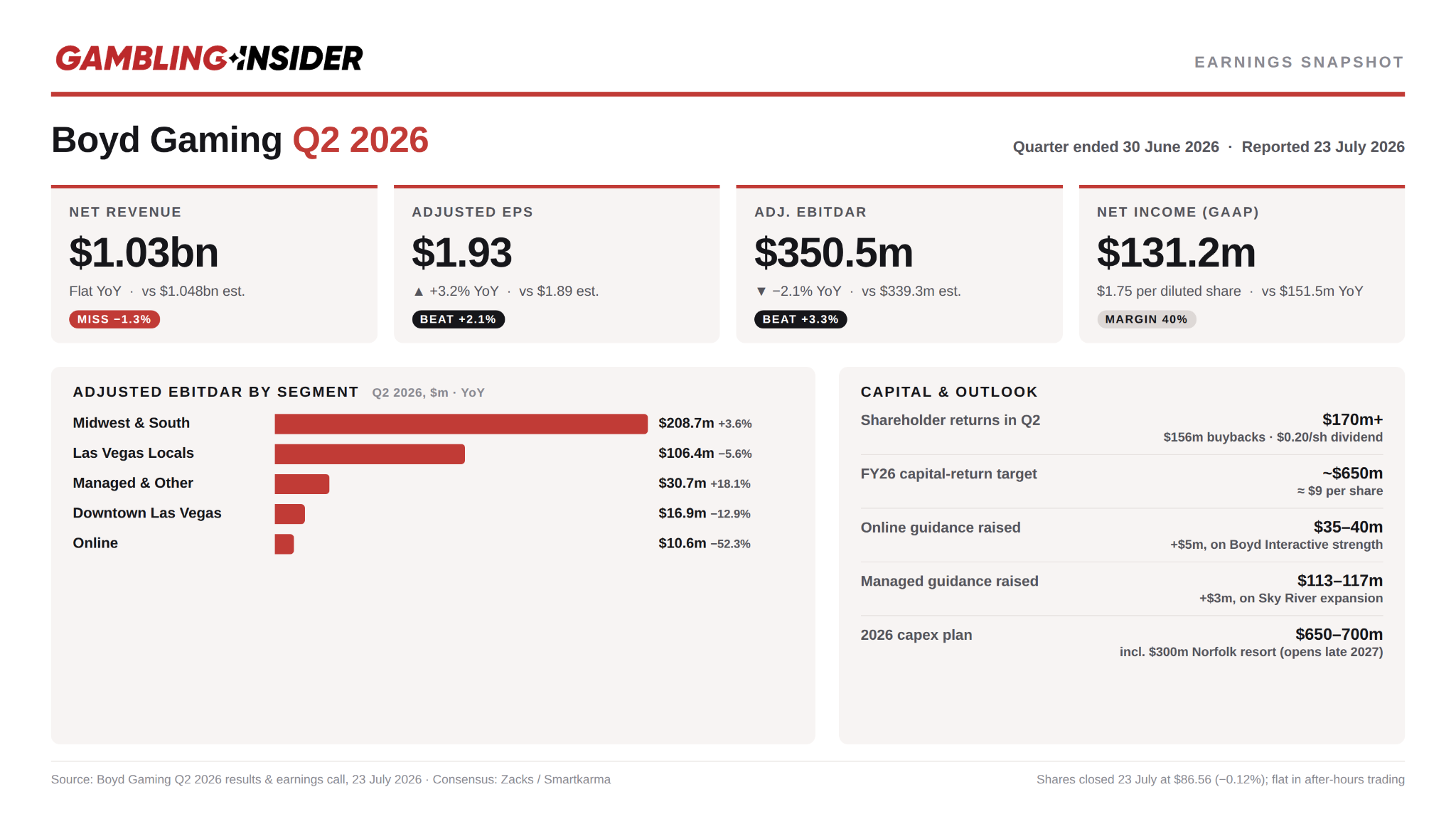
For the quarter ended June 30, Boyd Gaming reported net revenue of $1.03 billion, effectively flat year-over-year but falling roughly 1.3% short of the $1.048 billion consensus forecast. The results follow a mixed showing for Boyd in Q1 2026.
However, adjusted earnings per share (EPS) hit $1.93, edging past the $1.89 analyst consensus. The company reported adjusted EBITDAR of $350.5 million — a 2.1% dip from Q2 2025’s $357.9 million.
On a GAAP basis, net income was $131.2 million, or $1.75 per diluted share, down from $151.5 million ($1.84 per share) in the prior-year quarter.
Property operating margins held steady at a robust 40%, demonstrating management’s continued emphasis on cost discipline despite inflationary pressures and targeted construction disruptions.
Tale of Two Geographies: Midwest Strength vs. Locals Softness
The underlying narrative of Boyd’s second-quarter earnings is a sharp contrast between its powerhouse regional properties and stubborn headwinds in its Las Vegas segments.
The Midwest & South segment emerged as the quarter’s undisputed crown jewel. The division posted revenues of $556.9 million, an increase of 3.1% year-over-year. Adjusted EBITDAR for the segment reached $208.7 million, up 3.6% from the prior year, bolstered by property margin expansion to nearly 38%.
Management attributed the strength to sturdy demand from core and retail players, supplemented by the returns on recent food and beverage capital investments.
In contrast, the Las Vegas Locals segment — nine properties marketed to regional residents — displayed signs of wear, delivering $225.9 million in revenue compared to $229.1 million in Q2 2025. Adjusted EBITDAR also contracted from $112.7 million to $106.4 million.
The weakness was highly localized, primarily stemming from persistent softness in the destination business at the Orleans property and from deliberate construction-related disruptions at the Suncoast, where an extensive casino floor renovation is currently underway.
Meanwhile, Downtown Las Vegas mirrored this softness, with revenue dipping to $52.1 million from $55.3 million in the year-ago period and adjusted EBITDAR easing to $16.9 million from $19.4 million.
Online and Managed Operations Support the Outlook
The brightest spot outside of traditional regional gaming came from Boyd’s auxiliary operations. The Managed & Other business segment posted an 18.1% jump in EBITDAR, hitting $30.7 million on revenue of $41.3 million.
This surge was catalyzed by higher management fees from Sky River Casino, which recently completed the first phase of its expansion, including a larger casino floor and a new parking structure. A second phase, adding a 300-room hotel, spa, and further dining, is due for completion in early 2028.
The Online segment yielded $158.2 million in revenue and $10.6 million in EBITDAR, down from $173.1 million and $22.2 million a year earlier. That equates to a decline largely reflecting the amended economics of Boyd’s market-access agreements with FanDuel, rather than any weakness at Boyd Interactive, the company’s proprietary digital casino platform.
President and CEO Keith Smith and CFO Josh Hirsberg provided essential context behind the numbers on the post-earnings conference call on Thursday evening, striking a confident yet grounded tone regarding the remainder of 2026.
In the company’s earnings release, Smith pointed directly to Boyd’s operating structure as its primary shield against regional economic turbulence:
Our second-quarter results demonstrated the benefits of our diversified business model, with strong performances from our Midwest & South operations, Online segment, and Managed business.
“Results for the quarter, on a comparable basis, reflect both revenue and Adjusted EBITDAR growth, with property operating margins of 40%, a level we have consistently delivered over the last several years.”
Smith specifically lauded the regional strength in the Midwest and South that buoyed the company’s bottom line:
First, our Midwest and South segment delivered a strong performance on top of last year’s solid results. Revenues grew 3% in the quarter, [driven] by growth in gaming revenues, while EBITDA grew 4% with property margin expanding to nearly 38%. This was the segment’s strongest margin in almost 2 years, demonstrating our continued ability to drive operating efficiencies throughout our business.”
Facing Up to Las Vegas Headwinds With a Bullish Pitch
Management did not shy away from the headwinds facing the Las Vegas Locals market, but actively parsed the data to highlight the segment’s underlying health when excluding isolated disruptions.
“Excluding the Orleans and Suncoast … revenues from these properties increased 4% in the quarter … while EBITDAR grew 3% and margins once again exceeded 50%,” Smith explained, suggesting that the local consumer remains resilient.
During the Q&A session, Truist Securities analyst Barry Jonas pressed the executives on the negative impact occurring at the Orleans. Hirsberg was frank in his assessment, noting it represents a systemic hurdle rather than a quick fix.
“It was a similar level at around $5 million of EBITDAR,” he said, ” … We just don’t see any indication that those trends are changing. … Our best estimate for Q3 [is] around $3 million.”
Hirsberg also quantified the ongoing capital project impact, saying, “Suncoast construction disruption. .. we estimate that to have been around $3 million for Q2,” adding that a similar level is expected in Q3.
The CFO delivered the most distinctly bullish commentary of the evening when announcing updated full-year projections for Boyd’s digital and managed segments.
As a result of Boyd Interactive’s strong performance, we are raising full-year guidance for our Online segment by $5 million to $35 million to $40 million for full-year 2026,” Hirsberg stated.
“Given the positive response to Sky River’s recent expansion, we are raising our guidance by $3 million for our Managed business to $113 million to $117 million for the full year.”
Heading into the earnings call, analyst sentiment had been guarded but improving, with a flurry of pre-earnings target hikes: Mizuho’s Ben Chaiken lifted his target to $101 from $96 (July 17), Morgan Stanley’s Stephen Grambling to $90 from $87 (July 22), JPMorgan’s Daniel Politzer to $93 from $90 (July 15), and Wells Fargo to $88 from $81 (July 14).
Benchmark’s Mike Hickey initiated coverage in June with a Buy rating and a $100 price target, emphasizing confidence in regional resilience. Goldman Sachs’ Lizzie Dove initiated at Neutral with a $91 target in late June, while Macquarie’s Chad Beynon trimmed his target to $91 from $95 in May.
Consensus currently sits in the mid-$90s: StockAnalysis tracks 18 analysts with an average 12-month target of roughly $95.50 (median $92), while MarketBeat’s consensus stands at $94.38 across 16 analysts, with targets ranging from $84 to $110 and ratings skewed toward Hold with a meaningful Buy contingent.
Market Reaction: Boyd Gaming’s Steady Hand to See it Through the Speed Bumps
The market reaction was muted but constructive. Boyd Gaming stock closed Thursday’s regular session at $86.56, down a marginal 0.12% on the day, ahead of the release.
In after-hours trading, the stock initially slipped to around $86.10 before recovering to finish the extended session essentially flat at $86.56–$86.59. The shares were unchanged in Friday’s pre-market.
The lack of a sell-off on the revenue miss suggests that resilient margins placated investors, an EPS beat, and upwardly revised guidance for the managed and digital segments.
Looking ahead, Boyd is leaning heavily into a bold capex cycle. The company reiterated its expectation to spend between $650 million and $700 million throughout 2026.
This heavy reinvestment covers the ongoing Orleans hotel remodel, the Cadence Crossing property (which opened in late March), design work at the Par-A-Dice casino in Illinois, and an ambitious $300 million injection this year into its estimated $750 million destination resort under construction in Norfolk, Virginia, slated to open in late 2027.
Despite these capital commitments, Boyd Gaming’s balance sheet remains highly liquid, with $322.7 million in cash and $2.6 billion in total debt at quarter-end. The company repurchased $156 million in shares during the second quarter, leaving $551 million under its current repurchase authorization, and paid a $0.20 per share dividend on 15 July.
With management reaffirming its goal of returning approximately $150 million per quarter to investors, tracking toward roughly $650 million, or about $9 per share, in total 2026 capital returns, Wall Street seems willing to wager that Boyd’s steady hand at the operational wheel will carry it through any localized speed bumps.
Boyd Gaming (NYSE: BYD) 2025–2026 Quarterly Financial Results
Below is a detailed breakdown of Boyd Gaming’s quarterly results covering Q1 2025 through Q2 2026. Year-over-year (YoY) changes compare the current quarter to the corresponding prior-year quarter. Actual results are compared against Wall Street consensus forecasts where published estimates are available.
| Period | Metric | Actual Result | YoY Change | Consensus Forecast | Beat / Miss | % Diff (vs Forecast) |
|---|---|---|---|---|---|---|
| Q1 2025 | Net Revenue | $991.6M | +3.2% | $970.0M | 🟢 Beat | +2.2% |
| Adj. EPS | $1.62 | +7.3% | $1.52 | 🟢 Beat | +6.6% | |
| Adj. EBITDAR | $337.5M | +2.1% | n/a* | – | – | |
| Q2 2025 | Net Revenue | $1,034.0M | +6.9% | $980.9M | 🟢 Beat | +5.4% |
| Adj. EPS | $1.87 | +18.4%† | $1.67 | 🟢 Beat | +12.0% | |
| Adj. EBITDAR | $357.9M | +4.0% | n/a* | – | – | |
| Q1 2026 | Net Revenue | $997.4M | +0.6% | $1,000.4M | 🔴 Miss | –0.3% |
| Adj. EPS | $1.60 | –1.2% | $1.72 | 🔴 Miss | –7.0% | |
| Adj. EBITDAR | $317.4M | –6.0% | n/a* | – | – | |
| Q2 2026 | Net Revenue | $1,034.4M | 0.0% (Flat) | $1,048.0M | 🔴 Miss | –1.3% |
| Adj. EPS | $1.93 | +3.2% | $1.89 | 🟢 Beat | +2.1% | |
| Adj. EBITDAR | $350.5M | –2.1% | $339.3M‡ | 🟢 Beat | +3.3% |
Adjusted EBITDAR = earnings before interest, taxes, depreciation, amortization, and rent/restructuring costs, the standard profitability metric for casino operators.
* No published Wall Street consensus for Adjusted EBITDAR is available for these quarters.
† Adjusted-vs-adjusted comparison: Q2 2025 adj. EPS of $1.87 vs. Q2 2024 adj. EPS of $1.58. (The previously cited +27.2% incorrectly compared 2025 adjusted EPS with 2024 GAAP EPS of $1.47.)
‡ Smartkarma consensus. Revenue and EPS consensus per Zacks/StockStory (2025 quarters), GuruFocus (Q1 2026), and pre-earnings sell-side consensus (Q2 2026).


Gambling Insider delivers the latest industry news, in-depth features, and operator reviews that you can trust. Our team combines rigorous editorial standards with decades of specialized expertise to ensure accuracy and fairness. We are committed to delivering clear, impartial, and dependable coverage across the global gambling sector.