As Trump Asks Congress to Pass Clarity Act, Better Markets Analyst Says Bill Will Fail; States and Tribes Will Prevail Over Prediction Markets
As President Trump called on Congress to pass the stalled Clarity Act, Better Markets' policy director Amanda Fischer predicted the bill to regulate cryptocurrency will ultimately fail and states and tribes will prevail over prediction markets.

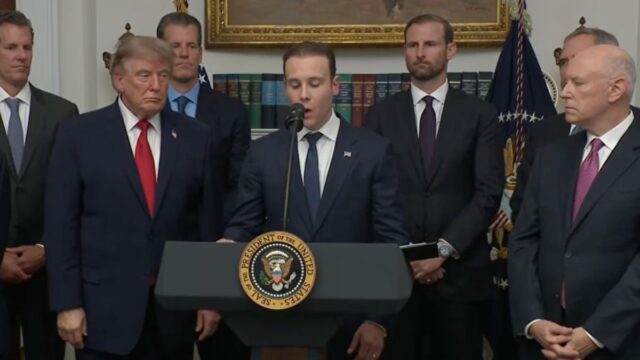
On the same day that President Donald Trump urged Congress to pass the Clarity Act during a White House meeting with CFTC chairman Michael Selig and top crypto executives, policy analyst Amanda Fischer predicted the bill to regulate cryptocurrency would ultimately fail.
Fischer is policy director and chief operating officer at Better Markets, which bills itself as an independent and nonpartisan nonprofit focused on America’s financial and economic issues. She was Chief of Staff at the Securities and Exchange Commission (SEC) under the Biden Administration.
The Senate did not vote on the Digital Asset Market Clarity Act before its August recess. Senate Majority Leader John Thune filed cloture on a motion to revisit the bill in mid-September, when lawmakers return to the capital.
In an appearance on Wednesday’s New Normal webcast with the Indian Gaming Association’s (IGA) Victor Rocha and David Bean, Fischer predicted unaddressed issues would stop the Clarity Act from getting the required cloture votes.
“I don’t think they get to 60,” said Fischer, “because there’s so many outstanding issues that need to be resolved… And frankly, I don’t even know if they can be.”
Fischer added that she thinks the crypto industry wants the vote so they “know who their friends and enemies are.” She suspects the lobby will use the result to inform political spending in the run-up to the upcoming election.
Clarity Act Hangs on Challenging, Unresolved Issues
During the webcast, Fischer highlighted several issues she sees holding up the Clarity Act:
- President Trump’s crypto business entanglements: Will Congress require him to divest, or will they “just put some window dressing on it?”
- Outstanding law enforcement concerns with decentralized markets
- Traditional financial industry concerns with crypto execs’ desire to “put the stock market on the blockchain and call it innovation”
- Concerns coming from Community bankers
Still, while referencing the Clarity Act at Wednesday’s meeting, Selig said the CFTC stands “ready to implement the bill.” The agency, he stressed, would “use every tool available to move the President’s pro-innovation agenda forward.”
Fischer, though, said that with every overstep, inflammatory tweet, attempt to invoke emergency powers, or questionable presidential business venture, it becomes very difficult for legislators to cooperate with what’s “very obviously a grift.”
Fischer also believes lawmakers are beginning to question reopening the Commodity Exchange Act to give Selig’s CFTC more power.
“If we’re handing all of this power to Mike Selig, what do his actions on prediction markets suggest about the judgment and trustworthiness?,” Fischer asked. During the Senate Indian Affairs Committee roundtable, Senators questioned enabling a CFTC “gone rogue,” she added.
Given just how much he has overstepped tribal and state authority on these issues, I think a lot of lawmakers are questioning whether or not they want to hand him more power.”
Selig Speech Targets Prediction Markets Opponents
Although prediction market executives were reportedly disinvited from Trump’s Wednesday audience with tech leaders, Selig’s address included targeted digs at their opponents.
After thanking Trump for his leadership, Selig said that “the era of political lawfare, de-banking, and regulation by enforcement is over.” The new financial frontier is “being built right here on American soil,” he added.
Speaking for just over three minutes, Selig called out New York Attorney General Letitia James for seeking to “nullify federal law” regarding prediction markets. He twice mentioned former SEC and CFTC chair Gary Gensler, who has criticized the CFTC’s handling of prediction markets under Selig.
Addressing Selig’s repeated targeting of her former SEC boss, Fischer dismissed the attacks by saying the industry needs a villain.
This industry needs to sell a narrative in order to hype their products. And as you all know, a narrative needs a villain. So they’re desperate to find a villain to rally around because there’s not a ton of intrinsic value in their proposition.”
Fischer: States and Tribes Will Prevail Over Prediction Markets
The states and tribes will prevail in their fight against prediction markets, Fischer believes.
Participating in the rulemaking underway at the CFTC is important, she said. Particularly to ensure the official administrative record accurately reflects what the CFTC is trying to do.
It’s also important because it creates another avenue with which to litigate with the CFTC.
CFTC Regulation 40.11, which governs how the agency reviews and may ban event contracts involving sensitive or prohibited activities, is “highly vulnerable to challenge from folks with standing,” she added.
It’s going to be really, really difficult for them to finalize the rule in a way that checks all of the boxes that the court has established for reasoned rulemaking; you can’t do things that are arbitrary and capricious. You need an economic analysis. You need to prove that what you’re doing is undergirded by the law.”
More important than the rulemaking is what’s happening in the courts, Fischer told The New Normal.
As you all know … your side has not had a 100% win rate, but it’s pretty good. If I had to pick a side that I thought would win in court when this is all settled, it will be your side.”
Rulemaking a ‘Feeble Attempt’ to Confuse a Losing Battle
Swaps, Fischer summarized, first emerged as a way for the agricultural community to hedge its risk.
After the financial crisis of 2008, she said Congress added more protections under the CFTC’s purview. Lawmakers then told the agency (under Gensler) to set boundaries. At that time, the agency instituted a bipartisan rule against contracts on war, terrorism, assassination, gaming, or things contrary to the public interest or illegal under state law.
Then, once President Trump was elected, there was an explosion of prediction markets that “just kind of wildly usurp the rule,” Fischer said. Now, the CFTC is stepping into litigation on the side of the markets.
The agency is trying to “tinker around the edges” to create the appearance of nuance, Fischer believes.
They’re throwing the kitchen sink at it to try to shore up their legal case in court and basically confuse judges… It’s a feeble attempt to try to shore up an area where they are overwhelmingly losing in court.”
If it All Ends, Prediction Markets ‘Had a Good Run’
If prediction markets wanted a better legal standing, they would have approached the CFTC for a rule change before offering sports contracts, Fischer said. While the exchanges still would have been vulnerable to legal challenges, they would have had a stronger case from the get-go, she said.
That would have been the more legally durable strategy, but it would have meant that they couldn’t have used this intervening time to accrue all of these profits.”
The prediction markets’ strategy is “not stupid,” she added. Even if the Supreme Court ultimately sides against them, they will have “had a good run.”
But without sports, what are prediction markets but a niche product, Fischer proded, echoing a sentiment Rocha, the webinar co-host, often expresses.
Still, the value proposition changes if there are disgorgements and penalties for past conduct, she said.
That’s why the Clarity Act matters, she added. In addition to codifying everything the Trump administration is already doing, it would provide amnesty for past misconduct.
Dozens of Congressional Hearings Expected
Asked by Rocha if Selig may one day face repercussions, Fischer said she doesn’t expect him to face civil or criminal prosecution.
What’s more likely, she added, is getting hauled before Congress to answer all manner of questions.
When I worked for Gary, when we were not doing anything unethical, we were put through the wringer… it can be rigmarole.”
The CFTC getting a front-page New York Times profile on alleged corruption is unusual, Fischer told The New Normal audience.
That high-level scrutiny will mean “full employment for DC lawyers,” helping prediction platforms respond to congressional oversight requests, Fischer predicted.
There have been multiple bills addressing prediction markets introduced in Congress in 2026, and with Democrats big favorites to win control of the House (84% on Kalshi) after this year’s midterms, legislative pressure on prediction markets and the CFTC is likely to increase.
Legislators, Fischer believes, will continue to push for congressional oversight.
It’s obvious, from her view, that the CFTC and prediction market lawyers are working in concert.
I cannot think of an example in my career of a federal agency moving so lockstep with firms that are the subject of litigation, and it’s obvious that their lawyers are coordinating… If I were Congress, I would definitely try to get my hands on those communications to see just the level of integration.”
“Given the salience of this issue, I would not be surprised if there’s not dozens of congressional hearings,” Fischer added.


Gambling Insider delivers the latest industry news, in-depth features, and operator reviews that you can trust. Our team combines rigorous editorial standards with decades of specialized expertise to ensure accuracy and fairness. We are committed to delivering clear, impartial, and dependable coverage across the global gambling sector.